The Grimace Trade: Why NFL Backup Quarterbacks Get Priced Before Anyone Announces Anything
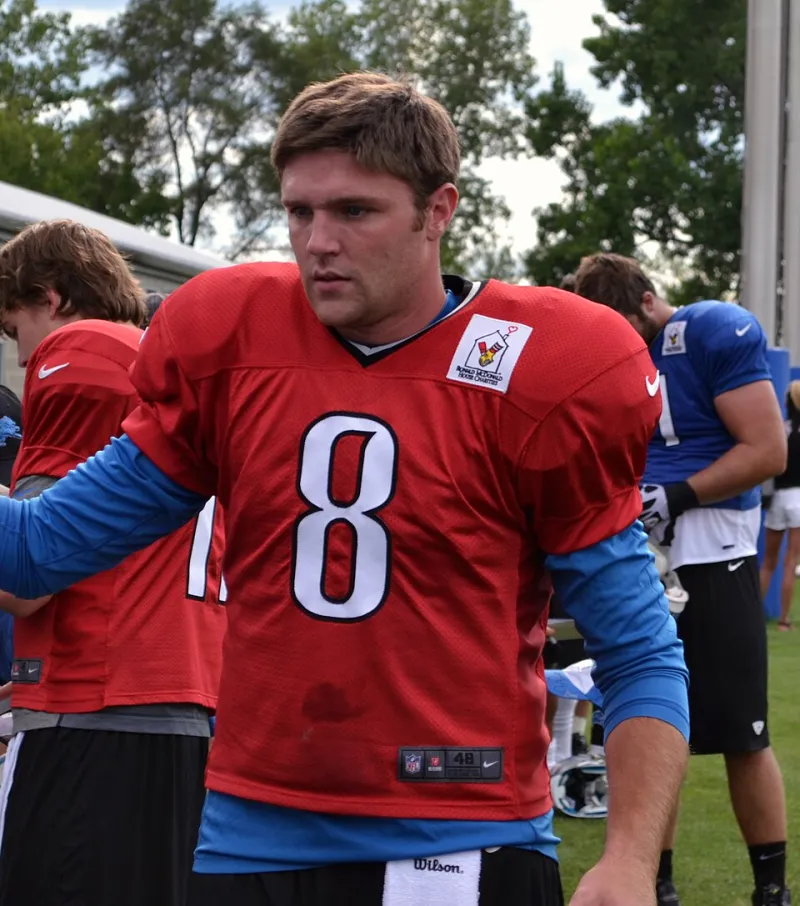
Photo: Kevind810, CC BY-SA 3.0, via Wikimedia Commons
There's a specific quiet that falls over an NFL stadium when the starting quarterback stays down a beat too long. The crowd noise drops to a murmur. The broadcast cuts to a tight shot of a face that's doing math. Then the cart comes out, the backup starts loosening up on the sideline with the nervous energy of a guy who hasn't thrown a meaningful pass since August — and somewhere in a risk room three states away, a trader's hand is already on the dial.
By the time the broadcast returns from commercial, the number has moved. Sometimes a full point. Sometimes two and a half.
That's the backup bump: the compressed, chaotic window between a bad landing and an official injury report, when sportsbooks, bettors, and the streaming analysts narrating the replay all start pricing a quarterback nobody has actually watched play real snaps. Midway through the 2026 season, it's become one of the most reliable — and most misread — patterns on the board.
The Window Is Shorter Than You Think
Here's what most fans don't register in the moment: the line usually moves before the team knows anything.
A starter takes a hit on a third-and-long in the second quarter. He walks off under his own power, sits on the bench, gets looked at by an athletic trainer, and disappears into the blue medical tent. At that exact moment, the information available to the market is: a guy is in a tent. That's it. That's the whole dataset.
And yet the spread on the live market can swing two points in ninety seconds, because the read isn't really about the injury. It's about the backup. And the backup is a known unknown — a former Day 3 pick with a strong arm and no idea what a blitz looks like at full speed, or a journeyman who's started fourteen games across four teams and is basically a known quantity with a low ceiling.
Traders aren't pricing the injury. They're pricing the gap between the starter and the guy holding the clipboard. That gap is the backup bump, and in 2026 it has been wider than usual, because more teams are carrying developmental quarterbacks who have never taken a snap in a game that mattered.
When the First Move Is Real
Not every knee-jerk adjustment is noise. Some of it is the smartest money on the board moving before the news cycle catches up.
A genuine first move usually has three fingerprints:
It's small and mechanical. Books shave a half-point, drop the total by a field goal, and wait. They are not trying to guess — they are trying to protect. A guy who immediately takes the number from -6.5 to -11 is either working with information you don't have or working with adrenaline they shouldn't.
The total moves first. This is the tell. A backup's arrival doesn't just affect who wins; it affects pace, play calling, and how aggressively an offensive coordinator trusts the middle of the field. When the spread barely budges but the total falls three points, the market is telling you something about game script, not about talent.
The team's own behavior confirms it. Watch the sideline, not the ticker. If the starter is back on the bench with a tablet and a headset by the next possession, the market is already behind. If the backup is taking first-team practice reps on the sideline between series, the move is probably still catching up.
The 11W Sports rule of thumb: the first half-point is almost always information. The third point is usually emotion.
When It's Just Panic in a Headset
We've all seen the other version. The starter gets up, walks off, shakes his head once, and a certain kind of bettor immediately fires on the backup — sight unseen — because the backup has "fresh legs" or "nothing to lose" or whatever the phrase of the week is.
That's not handicapping. That's a reaction to a highlight.
And that's where the streaming side of this gets dangerous. A hit gets replayed five times in a row. The slow-motion angle makes a routine tackle look like a car crash. The sideline reporter says the word "evaluation," which sounds ominous but is literally what happens to every player who gets touched. Meanwhile, your stream is running thirty to forty seconds behind the book, so the emotional peak of the moment arrives after the market has already digested it.
By the time you feel the panic, you're buying the panic at retail.
Three Questions Before You Chase the Move
The backup bump creates a weird trap: the number gets softer, which makes a bad team look tempting, and tempting numbers are how bankrolls go to die. Before you touch a game in that window, ask yourself three things.
One: Who is actually under center? Not "who might be." Who is on the field for the next snap. If you can't answer that with certainty, you're not betting a game — you're betting a rumor.
Two: Does this backup change the playbook or just the personnel? A mobile backup in a timing-based offense is a different team. A backup who's a carbon copy of the starter with a weaker arm is roughly the same team, minus a couple of explosive plays. Those two situations should not be priced the same way, and sometimes they are.
Three: Is there a better bet in the same game? When the starting quarterback goes down, the market's attention goes with him. Rushing props, receiving lines, and second-half totals can lag behind the main line for hours. The sharpest money in these windows often isn't on the quarterback at all — it's on the running back who suddenly gets eight more carries, or the tight end who becomes a safety valve.
The Backup Bump Never Lasts
The good news is that this is a short-lived market. Within 24 to 48 hours, the official report lands, the practice reports come out, and the number settles into something approaching the truth. The backup bump exists only in the fog — those first few hours when everybody's guessing and nobody's saying so.
That fog is where a lot of money changes hands, and most of it moves in one direction: away from the patient.
So when the cart comes out this Sunday and your phone starts buzzing with "did you see that," remember what you're actually looking at. You're not looking at an injury. You're not even looking at a backup. You're looking at a gap — the space between what the market knows and what the crowd fears — and gaps like that get priced faster than they get understood.
Every match. Every odd. Every highlight. Just make sure you know which of the three you're reacting to.